
Highlights Table
| Topic | Details |
|---|---|
| Tournament | FIFA World Cup 2026 |
| Hosts | United States, Canada & Mexico |
| Teams | 48 National Teams |
| Groups | 12 Groups (A to L) |
| Group Format | 4 Teams in Each Group |
| Qualification | Top 2 teams from each group + Best 8 third-placed teams qualify |
| Knockout Stage | Round of 32, Round of 16, Quarter-finals, Semi-finals, Third-place Match & Final |
| Standings Updated | After Every Matchday |
| Key Ranking Factors | Points, Goal Difference, Goals Scored, Head-to-head, Fair Play, FIFA Ranking |
| Official Tournament Dates | June 11 to July 19, 2026 |
| Current Focus | Final Group Matches and Round of 32 Qualification Race |
FIFA World Cup 2026 Standings
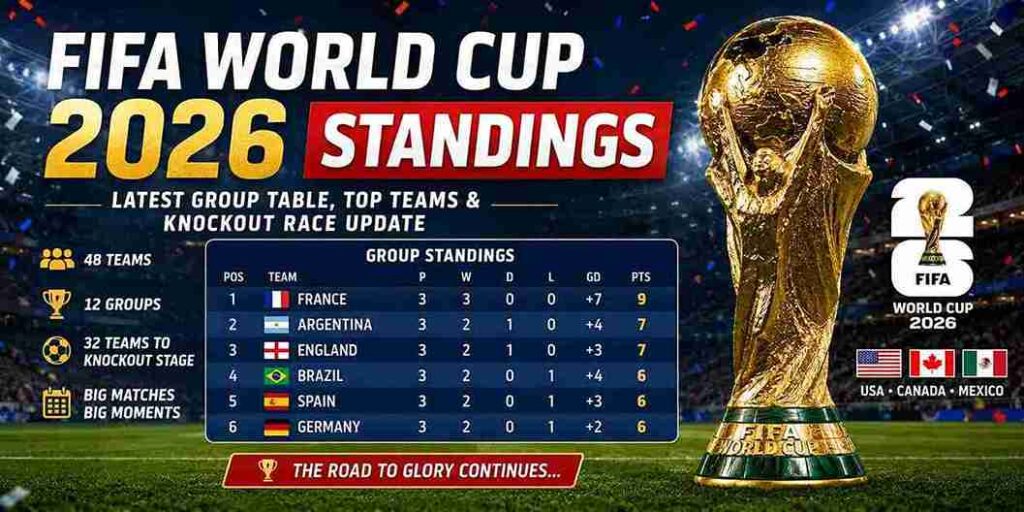
The FIFA World Cup 2026 standings have become one of the most searched topics during the tournament as football fans across the globe closely follow every point, goal difference, and qualification scenario. With the FIFA World Cup expanding from 32 to 48 teams for the first time in history, the competition has become even more exciting and unpredictable.
Hosted jointly by the United States, Canada, and Mexico, the 2026 FIFA World Cup introduced a brand-new tournament format featuring 12 groups of four teams. Every match now carries greater significance because not only do the top two teams from each group qualify automatically, but the eight best third-placed teams also advance to the Round of 32. This means that even teams finishing third remain in contention until the final group-stage matches.
Understanding the FIFA World Cup 2026 Standings
The standings table reflects how every team is performing throughout the group stage. Each team plays three matches against the other teams in its group.
The points system remains familiar:
- Win: 3 Points
- Draw: 1 Point
- Loss: 0 Points
However, because multiple teams often finish level on points, the rankings depend on several additional criteria.
The official tiebreakers include:
- Points
- Goal Difference
- Goals Scored
- Head-to-head record
- Fair Play (disciplinary record)
- FIFA Ranking (if necessary)
Goal difference has already proved decisive for several teams, while the expanded format has made the race among third-placed teams particularly dramatic.
New Format Makes the Standings More Important Than Ever
The biggest change in FIFA World Cup 2026 is the expansion from 32 to 48 participating nations.
Instead of eight groups, there are now 12 groups (A through L).
Qualification works as follows:
- 12 Group Winners qualify.
- 12 Group Runners-up qualify.
- 8 Best Third-Placed Teams also qualify.
This creates a 32-team knockout stage, replacing the previous Round of 16. Teams are no longer eliminated simply because they finish third, making every goal and every yellow card potentially crucial.
Current Standings Overview
Several football giants have already secured impressive positions during the group stage.
Among the standout performers are:
- Mexico
- Brazil
- France
- Spain
- Netherlands
- Switzerland
- Germany
- Belgium
France has looked particularly dominant, winning all three group matches, while Mexico has impressed the home crowd by topping Group A. Belgium secured first place in Group G after a commanding victory over New Zealand, with Romelu Lukaku becoming Belgium’s all-time leading World Cup scorer.
Meanwhile, several groups remain undecided, with the final round of fixtures determining which third-placed teams will join the Round of 32.
The Battle for the Best Third-Placed Teams
Perhaps the most fascinating aspect of FIFA World Cup 2026 standings is the race among third-placed teams.
Unlike previous editions, third place does not necessarily mean elimination.
The eight highest-ranked third-place finishers across all 12 groups progress to the knockout stage.
This has created intense competition where even teams with four points cannot relax.
Goal difference, goals scored, and disciplinary records are separating teams that have identical records. Ecuador, Sweden, and Bosnia and Herzegovina were among the early teams to secure advancement as best third-place finishers, while several other nations remained dependent on results elsewhere.
Top Individual Performers Influencing the Standings
Individual brilliance has played a major role in shaping the standings.
Some of the biggest stars have delivered outstanding performances:
- Ousmane Dembélé
- Kylian Mbappé
- Vinícius Júnior
- Lionel Messi
- Romelu Lukaku
One of the tournament’s biggest stories came when Dembélé scored a remarkable first-half hat-trick for France against Norway, breaking multiple World Cup records and strengthening France’s position atop Group I.
Belgium’s Lukaku also made history by becoming his country’s all-time World Cup leading scorer.
Highest Scoring World Cup in History
Another remarkable feature of FIFA World Cup 2026 is the number of goals being scored.
Before the group stage was even completed, the tournament had already surpassed the total goals scored during the entire 2022 FIFA World Cup.
The expanded format naturally provides more matches, but attacking football and fewer defensive approaches have also contributed to record-breaking scoring numbers. Attendance records have also been surpassed, highlighting the tournament’s global appeal.
How Fans Can Track the FIFA World Cup 2026 Standings
The standings change after every completed match.
Fans should pay attention to:
- Total Points
- Matches Played
- Wins
- Draws
- Losses
- Goals Scored
- Goals Conceded
- Goal Difference
Because several groups are decided by fine margins, checking the updated standings after every matchday has become essential for understanding qualification scenarios.
What Happens After the Group Stage?
Once the group stage concludes:
- 24 teams qualify automatically by finishing first or second.
- 8 additional teams qualify as the best third-placed finishers.
- The tournament moves into the Round of 32.
- Every knockout match becomes win-or-go-home.
- Extra time and penalty shootouts decide tied matches.
The final will take place on July 19, 2026, bringing nearly six weeks of world-class football to an unforgettable conclusion.
FIFA World Cup Guides
If you want to explore the tournament in greater detail, these guides provide additional information:
- FIFA World Cup 2026 Schedule
- FIFA World Cup Groups Explained
- FIFA World Cup Winners List
- FIFA World Cup Golden Boot Race
- FIFA World Cup Records
- FIFA World Cup Host Cities
- FIFA World Cup Prize Money
- FIFA World Cup Final History
Final Thoughts
The FIFA World Cup 2026 standings are far more dynamic than in previous editions because of the tournament’s expanded format. Every point, goal, and disciplinary decision can influence qualification, especially in the race among the best third-placed teams.
With powerhouse nations such as France, Brazil, Spain, Argentina, England, Germany, and Mexico competing for the title, while emerging teams continue to produce surprises, the standings are changing almost daily. As the tournament moves toward the knockout rounds, fans can expect even more drama, unforgettable performances, and historic moments that will shape one of the greatest FIFA World Cups ever played.