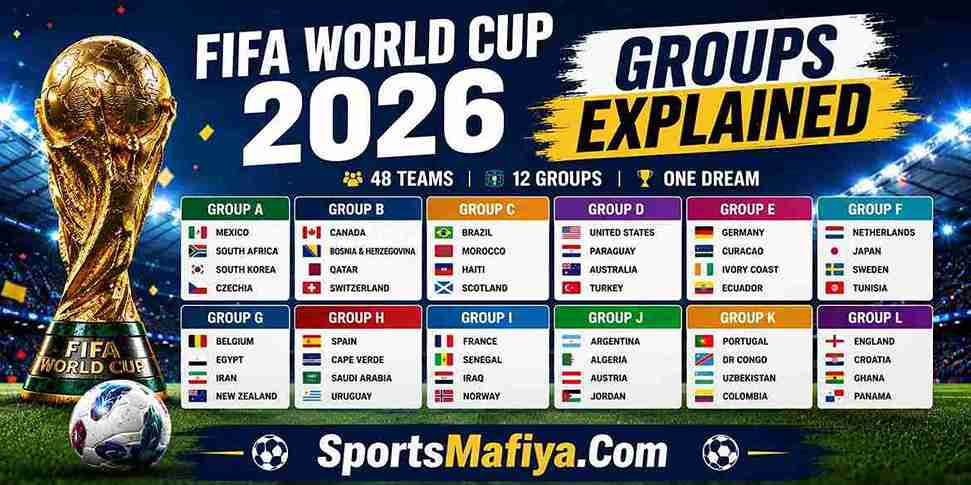

FIFA World Cup 2026 groups: The FIFA World Cup 2026 introduces the biggest change in the tournament’s history with 48 participating nations divided into 12 groups. The expanded format creates more exciting matchups, gives emerging football nations a chance to compete on the world stage, and makes the race to the knockout rounds more competitive than ever.
Understanding the FIFA World Cup 2026 groups is essential for following the tournament. Each group determines which teams advance, who faces whom in the knockout rounds, and how the path to the World Cup trophy unfolds.
In this guide, we’ll explain the complete group format, qualification rules, every World Cup group, and what makes the new system different from previous tournaments. If you also want to track which teams are currently leading their groups, check out our FIFA World Cup 2026 Standings guide.
FIFA World Cup 2026 Groups Highlights
| Feature | Details |
|---|---|
| Tournament | FIFA World Cup 2026 |
| Total Teams | 48 |
| Total Groups | 12 |
| Groups | A to L |
| Teams Per Group | 4 |
| Group Stage Matches Per Team | 3 |
| Automatic Qualification | Top 2 teams from each group |
| Additional Qualification | 8 Best Third-Placed Teams |
| Total Teams in Knockout Stage | 32 |
| Hosts | United States, Canada & Mexico |
What Are FIFA World Cup Groups?
The FIFA World Cup begins with the group stage, where all qualified teams are divided into smaller groups.
For the 2026 edition, FIFA has expanded the competition from 8 groups to 12 groups, with each group containing four national teams.
Every team plays one match against each opponent in its group, meaning every nation plays three matches before the knockout stage begins.
The group stage helps determine the strongest teams while ensuring every nation has multiple opportunities to compete before elimination.
FIFA World Cup 2026 Group Format
The expanded tournament follows a simple structure.
- 48 qualified nations
- 12 groups (A to L)
- Four teams in each group
- Three matches per team
- Three points awarded for a win
- One point for a draw
- Zero points for a loss
After all matches are completed, the teams are ranked based on:
- Total points
- Goal difference
- Goals scored
- Head-to-head record (where applicable)
- Fair play points
- FIFA tiebreak procedures if necessary
This system rewards consistency throughout the group stage.
FIFA World Cup 2026 Groups
| Group | Teams | Overview |
|---|---|---|
| Group A |
Mexico South Africa South Korea Czechia |
Host nation Mexico headlines Group A and enters as one of the favorites to qualify for the knockout stage. |
| Group B |
Canada Bosnia and Herzegovina Qatar Switzerland |
Canada, playing on home soil, hopes to capitalize on home advantage against experienced European and Asian opponents. |
| Group C |
Brazil Morocco Haiti Scotland |
This group combines one of football’s most successful nations with several highly competitive challengers. |
| Group D |
United States Paraguay Australia Turkey |
The United States enjoys home support, but every team in this group is capable of producing surprise results. |
| Group E |
Germany Curacao Ivory Coast Ecuador |
Germany enters as the favorite, while Ecuador and Ivory Coast provide strong competition. |
| Group F |
Netherlands Japan Sweden Tunisia |
One of the tournament’s most balanced groups, featuring technically gifted and disciplined teams. |
| Group G |
Belgium Egypt Iran New Zealand |
Belgium leads a competitive group where every point could prove decisive. |
| Group H |
Spain Cape Verde Saudi Arabia Uruguay |
Spain and Uruguay are expected to challenge for the top positions, but Cape Verde has already shown it can compete against stronger nations. |
| Group I |
France Senegal Iraq Norway |
France enters among the tournament favorites, while Norway and Senegal hope to secure qualification. |
| Group J |
Argentina Algeria Austria Jordan |
Defending champions Argentina are expected to top the group, but Austria and Algeria have the quality to challenge. |
| Group K |
Portugal DR Congo Uzbekistan Colombia |
Portugal and Colombia headline one of the tournament’s most exciting groups. |
| Group L |
England Croatia Ghana Panama |
England and Croatia renew a familiar rivalry, while Ghana and Panama aim to upset the established powers. |
How Teams Qualify from the Groups
One of the biggest changes in the 2026 tournament is the qualification process.
Instead of only the top two teams progressing, the tournament now allows:
- The top two teams from every group.
- The eight best third-placed teams.
This means 32 teams advance to the knockout stage.
Because of this expanded system, even teams finishing third still have a realistic chance of progressing.
As a result, every goal scored and every point earned becomes extremely valuable.
Why Goal Difference Matters
Many fans focus only on points, but goal difference often determines qualification.
If two or more teams finish with the same number of points, FIFA applies several tiebreakers.
The order generally includes:
- Goal difference
- Goals scored
- Head-to-head performance
- Fair play record
This means teams continue attacking even when leading comfortably because additional goals could prove decisive later.
Which Is the Toughest Group?
Every World Cup features at least one “Group of Death.”
Based on the quality of participating nations, several groups appear particularly competitive.
Group C combines Brazil, Morocco, Scotland, and Haiti.
Group H includes Spain and Uruguay alongside ambitious challengers.
Group L features England, Croatia, Ghana, and Panama, making qualification anything but straightforward.
As the tournament progresses, these groups are expected to produce some of the most entertaining matches.
How the Groups Affect the Knockout Bracket
Group positions directly influence the knockout schedule.
Winning a group often results in a more favorable Round of 32 opponent.
Finishing second may lead to a tougher path, while the best third-placed teams enter a different section of the bracket.
Because of this, even already-qualified teams continue fighting to finish first in their group.
Why Understanding the Groups Is Important
Knowing the groups helps fans:
- Predict knockout matchups.
- Follow their favorite team.
- Understand qualification scenarios.
- Track rival teams.
- Analyze potential championship paths.
For fantasy football players, sports analysts, and casual supporters alike, understanding the group stage adds another layer of excitement to the tournament.
Frequently Asked Questions
| How many groups are in FIFA World Cup 2026? |
|---|
| The tournament has 12 groups, labeled Group A through Group L. |
| How many teams are in each group? |
| Each group contains four teams. |
| How many matches does each team play? |
| Every team plays three group-stage matches. |
| How many teams qualify from each group? |
| The top two teams qualify automatically, while the eight best third-placed teams also advance. |
| What happens after the group stage? |
| The qualified teams move into the Round of 32, followed by the Round of 16, Quarter-finals, Semi-finals, and Final. |
Final Thoughts
The FIFA World Cup 2026 groups are central to understanding how the tournament unfolds. With 48 nations competing across 12 groups, the expanded format creates more competitive football and gives more countries a realistic opportunity to reach the knockout stage.
Whether you’re following a traditional powerhouse like Argentina, Brazil, France, or England, or cheering for an emerging football nation, every group match plays a crucial role in shaping the road to the World Cup title.
To stay updated throughout the tournament, be sure to explore our related guides, including FIFA World Cup 2026 Standings, FIFA World Cup 2026 Schedule, and the complete FIFA World Cup guide for everything you need to know about the world’s biggest football tournament.