
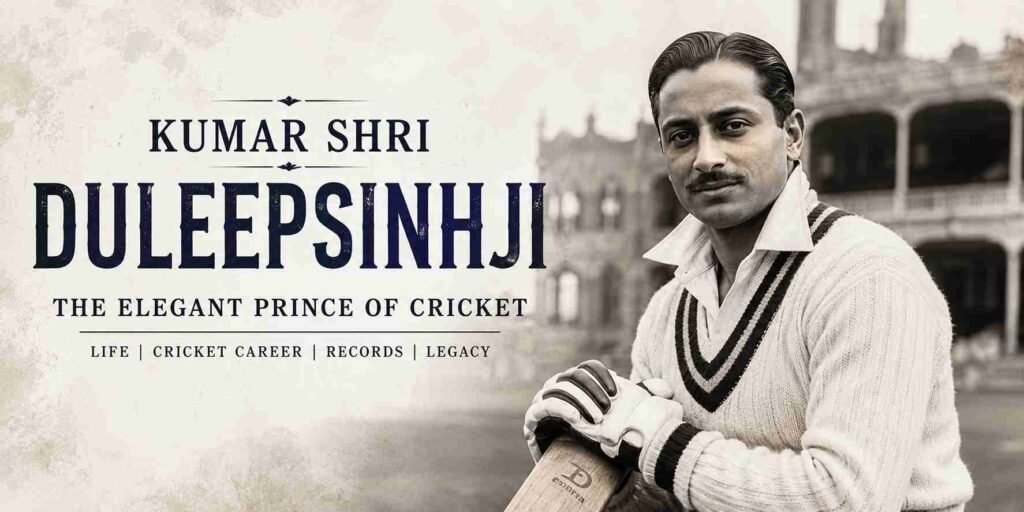

Kumar Shri Duleepsinhji, popularly known simply as Duleepsinhji or Duleep, was one of the most elegant batsmen of the golden era of English cricket. Born in Kathiawar in British India in 1905, he belonged to the royal family of Nawanagar and was the nephew of legendary cricketer Kumar Shri Ranjitsinhji, whose name is attached to India’s Ranji Trophy.
Although Duleepsinhji was Indian by birth and heritage, he represented England in Test cricket because India did not yet have Test status during his playing career. Between 1929 and 1931, he played 12 Tests and scored 995 runs at the extraordinary average of 58.52, including three centuries and five fifties. His highest Test score was 173 against Australia at Lord’s in 1930.
His first-class record was even more extensive. In 205 matches, Duleepsinhji scored 15,485 runs, including 50 centuries and 64 fifties, at an average just below 50. He also took 28 wickets with his occasional right-arm leg-break bowling and 256 catches.
His career was remarkably short because recurring health problems forced him away from cricket while he was still at the height of his powers. Yet his reputation remained enormous. He was named one of Wisden’s Cricketers of the Year in 1930, and his name lives on through the Duleep Trophy, one of India’s major domestic first-class competitions.
Kumar Shri Duleepsinhji Biography: Highlights
| Highlight | Details |
|---|---|
| Full name | Kumar Shri Duleepsinhji |
| Popular name | Duleep / Duleepsinhji |
| Born | 13 June 1905 |
| Birthplace | Sarodar, Kathiawar, British India |
| Present-day region | Gujarat, India |
| Died | 5 December 1959 |
| Age at death | 54 |
| Batting style | Right-handed |
| Bowling style | Right-arm leg-break |
| Primary role | Batsman |
| International team | England |
| Test career | 1929–1931 |
| Test matches | 12 |
| Test runs | 995 |
| Test batting average | 58.52 |
| Test centuries | 3 |
| Test fifties | 5 |
| Highest Test score | 173 |
| First-class matches | 205 |
| First-class runs | 15,485 |
| First-class centuries | 50 |
| First-class highest score | 333 |
| Major domestic teams | Sussex, Cambridge University, Hindus |
| Famous first-class innings | 333 for Sussex against Northamptonshire |
| Major honour | Wisden Cricketer of the Year, 1930 |
| Famous relative | Ranjitsinhji, uncle |
| Later career | Indian diplomat and public servant |
| Famous legacy | Duleep Trophy named in his honour |
Who Was Kumar Shri Duleepsinhji?
Kumar Shri Duleepsinhji was an Indian-born cricketer who became one of the leading batsmen in England during the late 1920s and early 1930s.
His story is unusual because he belonged to India but played international cricket for England. This was not unusual in the context of the period. India had not yet gained Test status, and the country’s first official Test match would not take place until 1932.
Duleepsinhji therefore played at a time when questions of nationality, empire, education and sporting opportunity were closely intertwined.
He was born into the royal family of Nawanagar, a princely state in Kathiawar. His uncle, Ranjitsinhji, had already become an international cricketing icon after representing England. Duleepsinhji followed a remarkably similar route, moving to Britain, attending prestigious schools and universities, and eventually establishing himself as a star of English county cricket.
What made Duleepsinhji particularly remarkable was not simply his background. It was his batting.
Contemporary observers admired his timing, wristwork, footwork and ability to score without appearing to force the game. Sussex Cricket Museum describes him as an exceptionally gifted batsman and records the praise he received while still playing school cricket.
His career was short, but the numbers he produced were extraordinary.
Early Life and Family Background
Kumar Shri Duleepsinhji was born on 13 June 1905 in Sarodar in Kathiawar, British India, in what is now the Gujarat region of India. He came from the royal family of Nawanagar.
His family had an extraordinary connection with cricket.
His uncle was Kumar Shri Ranjitsinhji, one of the most famous batsmen of the early international era. Ranjitsinhji had represented England and became famous for his distinctive strokeplay, particularly the leg glance. The Ranji Trophy, India’s premier domestic first-class competition, was later named after him.
Duleepsinhji consequently grew up within a family that had already established a remarkable connection between Indian royalty and English cricket.
But Duleepsinhji was not simply riding on his uncle’s reputation.
He developed into an exceptional cricketer in his own right.
He was educated initially in India before moving to Britain in 1921. He attended Cheltenham College, where his cricketing ability quickly attracted attention. Later he went to Clare College, Cambridge, where he continued to develop as a batsman and earned his cricket Blue.
His arrival in Britain was therefore a major turning point in his life.
It placed him inside the English educational and cricketing system at a time when that system represented one of the strongest competitive environments in the world.
Duleepsinhji’s Cricketing Education at Cheltenham
Duleepsinhji’s talent became obvious while he was still a schoolboy.
At Cheltenham College, he rapidly established himself as an exceptional batsman. His natural gifts attracted the attention of prominent cricket figures, including H. S. Altham, who later became president of the Marylebone Cricket Club.
Sussex Cricket Museum records Altham’s assessment of the young Duleepsinhji as being far above the ordinary school batsman, particularly praising his eye, wristwork, footwork and judgment.
This is important because Duleepsinhji’s batting style would later become one of the defining features of his career.
He was not primarily a brute-force batsman.
His strength was timing.
He could find gaps, manipulate the ball with his wrists and play strokes with an economy of movement that made his batting appear effortless.
That elegance inevitably invited comparisons with his uncle Ranjitsinhji.
But Duleepsinhji developed his own style and eventually built a statistical record that stood comfortably on its own.
Cambridge University Cricket Career
After Cheltenham, Duleepsinhji entered Cambridge University.
He gained his Blue in his first year by playing in the Varsity Match, an enormous achievement for a young cricketer.
His Cambridge career included several outstanding performances.
One particularly notable innings came in 1927, when he scored 246 not out against Middlesex. Sussex Cricket Museum records the innings among his major university achievements.
Cambridge gave Duleepsinhji an important platform.
University cricket was highly respected in England, and performances there could lead to opportunities in county cricket and eventually international selection.
Duleepsinhji was now moving through that pathway at remarkable speed.
Beginning His Sussex Career
Duleepsinhji had already made an impression on Sussex before becoming an established Cambridge player.
He began playing for Sussex in 1924, although his regular county career developed later. Sussex Cricket Museum notes that he started playing for his uncle’s old team and subsequently played regularly for the county after his Cambridge years.
Sussex would become the central domestic team of his career.
From 1926 onward, Duleepsinhji became a major force in the county championship.
He consistently produced large scores and developed a reputation as one of the most stylish batsmen in English domestic cricket.
His relationship with Sussex eventually went beyond batting.
He became captain of the county and helped establish the team as a serious championship contender during the early 1930s.
The Incredible 333 Against Northamptonshire
One of the most extraordinary innings of Duleepsinhji’s career came in 1930, when he scored 333 for Sussex against Northamptonshire at Hove.
The innings was remarkable not merely because of its size.
He scored the runs in approximately 330 minutes, and Sussex Cricket Museum records that he batted from the fall of the first wicket until the score reached 510 before being dismissed.
He shared a partnership of 255 with Maurice Tate, while most of his teammates contributed relatively little.
The innings became one of the defining achievements of his career.
Duleepsinhji’s 333 remained Sussex’s highest individual score until Murray Goodwin scored 335 in 2003. The Sussex Cricket Museum notes that, although the record was eventually surpassed, no player had scored more runs for Sussex in a single day than Duleepsinhji’s historic effort.
The performance demonstrated several qualities that defined his batting:
- Exceptional concentration
- Rapid scoring
- Outstanding strokeplay
- Ability to bat for a long period
- Control against different types of bowling
- Extraordinary consistency
It was not simply a large score. It was a statement that Duleepsinhji belonged among the best batsmen in English cricket.
Selection for England
Duleepsinhji’s domestic performances inevitably brought him into England’s selection picture.
He was selected for England in 1929.
His Test debut came against South Africa at Edgbaston in June 1929.
The circumstances surrounding his selection were historically significant.
Duleepsinhji was an Indian-born, non-white cricketer representing England during the British colonial period. His selection was therefore about more than cricket.
There was also controversy surrounding his non-selection for England’s tour of South Africa after he had initially been selected for England’s Test side. Historical accounts record suspicion that racial politics in South Africa influenced the decision. The South Asian Britain project notes that Duleepsinhji himself believed racial considerations played a role.
The episode illustrates how cricket during the period was inseparable from the social and political realities of the British Empire.
Duleepsinhji nevertheless continued to perform at a level that made his talent impossible to ignore.
Test Debut for England
Duleepsinhji made his Test debut against South Africa in 1929.
His international career lasted only 12 Tests, but the numbers were extraordinary.
He scored:
995 runs in 12 Tests at an average of 58.52.
He recorded:
- 3 centuries
- 5 fifties
- Highest score of 173
- 10 catches
His career average is one of the most striking features of his statistical record.
For context, an average above 50 in Test cricket is generally associated with elite batting.
Duleepsinhji’s average of 58.52 therefore places his short Test career among the most productive in the history of the format.
The obvious caveat is sample size. Twelve Tests are far fewer than the careers enjoyed by many later greats.
Nevertheless, the quality of his output is undeniable.
The Famous 173 Against Australia
Duleepsinhji’s most famous Test innings came against Australia at Lord’s in 1930.
He scored 173 in the second Test of the 1930 Ashes series. ESPN’s historical account describes it as his highest Test score and notes that he played a major role in England’s first innings, with only Maurice Tate among his teammates also passing fifty.
The innings became part of Duleepsinhji’s cricketing mythology.
It was not just the number 173 that attracted attention. His style was central to the admiration surrounding him.
He was renowned for elegant strokeplay, particularly against spin bowling.
His ability to use his wrists and manipulate the ball around the field made him difficult to contain.
The innings also carried emotional significance because his uncle Ranjitsinhji was reportedly present to watch him.
The cricketing connection between uncle and nephew made the occasion especially memorable.
Duleepsinhji and Ranjitsinhji
It is impossible to tell Duleepsinhji’s story without discussing Ranjitsinhji.
Both were born into the Nawanagar royal family.
Both attended Cambridge.
Both represented England.
Both became famous for elegant batting.
And both eventually had major Indian domestic cricket competitions named after them.
Ranjitsinhji gave his name to the Ranji Trophy.
Duleepsinhji gave his name to the Duleep Trophy.
This creates one of the most unusual family legacies in cricket history.
The similarities, however, should not obscure their differences.
Ranjitsinhji played a much longer international career and became one of the defining batsmen of the Victorian and Edwardian eras.
Duleepsinhji’s career was much shorter because of illness.
Yet Duleepsinhji’s Test average was remarkably high, and his first-class record demonstrates that his ability was not limited to a handful of international performances.
Duleepsinhji’s Batting Style
Duleepsinhji was primarily a right-handed batsman.
His batting was characterised by elegance, timing and wristwork rather than excessive physical force.
Contemporary descriptions emphasised his ability to play the ball late and find gaps.
This style was particularly effective against spin.
He could use his feet, wrists and timing to disrupt a bowler’s plans without appearing hurried.
His batting also had an unusual quality of balance.
There was a sense of economy in his movement.
He did not need to overhit the ball to score quickly.
That characteristic became particularly evident in his enormous first-class innings, including the 333 against Northamptonshire.
His career demonstrates an important truth about batting: power is only one way to dominate.
Timing can be just as destructive.
First-Class Career Statistics
Duleepsinhji’s first-class career was far larger than his international career.
According to CricketArchive’s career statistics, he played 205 first-class matches, scored 15,485 runs, averaged 49.95, and made 50 centuries and 64 fifties. His highest score was 333.
His first-class record can be summarised as follows:
| Category | Record |
| Matches | 205 |
| Runs | 15,485 |
| Batting average | 49.95 |
| Centuries | 50 |
| Fifties | 64 |
| Highest score | 333 |
| Catches | 256 |
| Wickets | 28 |
| Best bowling | 4/49 |
These numbers reveal just how productive Duleepsinhji was over his domestic career.
Fifty first-class centuries is an extraordinary achievement.
More importantly, he maintained an average close to 50 across more than 200 matches.
That provides strong evidence that his international success was not a statistical accident.
Duleepsinhji as a Fielder
Duleepsinhji was also an accomplished fielder.
He was particularly effective in the slips and accumulated a substantial number of catches.
CricketArchive records 256 catches in 205 first-class matches, while he took 10 catches in his 12 Tests.
In an era when fielding standards were different from modern cricket, slip catching was still a specialist skill.
A batsman who could contribute heavily with the bat and provide reliable catching value was particularly valuable to a county side.
Duleepsinhji as a Bowler
Bowling was not Duleepsinhji’s primary role, but he was an occasional right-arm leg-break bowler.
His first-class record lists 28 wickets, with best figures of 4 for 49.
At Test level, however, he bowled only six deliveries and did not take a wicket.
His legacy therefore rests firmly on his batting.
Wisden Cricketer of the Year
Duleepsinhji’s achievements were recognised by Wisden in 1930, when he was named one of the five Cricketers of the Year.
That honour came during the period when his international reputation was rapidly growing.
The 1930 group also included Ted Bowley, Tuppy Owen-Smith, Walter Robins and Bob Wyatt.
Being selected as a Wisden Cricketer of the Year was one of the highest honours available to a cricketer at the time.
It confirmed that Duleepsinhji was regarded as one of the outstanding players of his generation.
Captaincy of Sussex
Duleepsinhji’s development eventually led to leadership responsibilities.
He captained Sussex during the early 1930s.
His captaincy coincided with a period when Sussex were genuine contenders for the County Championship. Sussex Cricket Museum records that the brilliance of Duleepsinhji’s batting and leadership helped the county come close to winning the championship, although they ultimately fell short.
The captaincy demonstrated that his contribution was not restricted to individual batting performances.
He was regarded as a leader capable of shaping a team.
Unfortunately, his physical condition increasingly interfered with his ability to continue playing.
Illness and the End of His Cricket Career
Duleepsinhji’s career was cut short by recurring health problems.
Illness had already affected his cricket before his final years. Historical records describe periods in which he needed medical treatment and time away from the game.
By 1932, his health had become a major concern.
He had initially been selected for the MCC’s 1932-33 tour of Australia, the famous Bodyline tour led by Douglas Jardine. However, Duleepsinhji withdrew because of ill health. ESPN’s Bodyline timeline records his withdrawal in August 1932 and his subsequent decision not to tour Australia.
His withdrawal was a major loss for England.
Duleepsinhji was one of the prominent players initially selected for the tour, but his health prevented him from participating.
The following period effectively brought his playing career to an end.
Sussex Cricket Museum records that doctors advised him not to continue playing after the 1932 season.
The tragedy was that Duleepsinhji was still only in his late twenties.
His cricket career had reached elite status, yet illness prevented him from enjoying the long international career that his ability appeared to promise.
What Might Duleepsinhji Have Achieved?
This is one of the most intriguing questions surrounding his career.
Duleepsinhji played only 12 Tests.
His average was 58.52.
He had already scored three Test centuries.
His first-class record contained 50 centuries.
And he was still relatively young when illness forced him away from the game.
It is impossible to know how many runs he would have scored had he remained healthy.
He could have played through the 1930s alongside some of the greatest batsmen of the era.
He might have played a major role in England’s Ashes campaigns.
He might have accumulated thousands more Test runs.
But cricket history is filled with careers shaped by injuries and illness.
Duleepsinhji’s legacy therefore rests partly on what he accomplished and partly on the tantalising possibility of what he might have achieved.
Why Duleepsinhji Did Not Play Test Cricket for India
A common question about Duleepsinhji is why an Indian-born cricketer played for England rather than India.
The answer is largely historical.
India did not have Test status during Duleepsinhji’s playing career.
India’s first official Test match came in 1932, after Duleepsinhji had effectively ended his cricket career.
Therefore, when Duleepsinhji was playing international cricket in the late 1920s and early 1930s, England was the Test side available to him through his cricketing career in Britain.
His story should therefore not be interpreted through the modern framework of international cricket eligibility.
The cricketing world of the 1920s was very different from today’s structure.
Duleepsinhji and Race in Cricket
Duleepsinhji’s career also has an important historical dimension.
He was a non-white cricketer representing England during a period when racial discrimination was widespread across the British Empire.
His selection and treatment were therefore significant.
South Asian Britain records that there was controversy surrounding his exclusion from the South African tour and that Duleepsinhji believed racial politics influenced the decision.
Sussex Cricket Museum similarly records the strong suspicion that political opposition to a non-white cricketer playing against South Africa influenced his omission.
His success consequently had a meaning beyond statistics.
Every major innings challenged assumptions about who could occupy the highest levels of English cricket.
His achievements also contributed to the broader history of South Asian participation in British sport.
Life After Cricket
Duleepsinhji’s story did not end when his cricket career ended.
He eventually returned to India and moved into public service and diplomacy.
Sources record that he later served as India’s High Commissioner to Australia and New Zealand and subsequently held a senior public-service role in Saurashtra.
This second career demonstrates that his abilities extended well beyond sport.
His education at Cheltenham and Cambridge had given him experience within British institutions, while his royal background and international connections gave him a distinctive position in public life.
After cricket, he was able to use those experiences in diplomatic and administrative roles.
Duleepsinhji as a Diplomat
His appointment as India’s representative in Australia and New Zealand was particularly interesting given his cricketing history.
Australia was one of the countries where he had played international cricket.
He was therefore returning to a region he already knew through sport, but now in a diplomatic capacity.
The transition from international cricketer to diplomat was remarkable.
It also reflected the changing political landscape of the subcontinent.
The man who had once represented England in cricket now served independent India in public office.
His life consequently crossed two very different eras of South Asian history: the colonial sporting world in which he played cricket and the post-independence period in which he served India.
Death of Kumar Shri Duleepsinhji
Kumar Shri Duleepsinhji died on 5 December 1959 in Bombay, now Mumbai.
He was only 54 years old. Historical sources report that he died following a heart attack.
His death marked the end of a remarkable life that had included:
- Indian royal heritage
- British education
- Cambridge cricket
- Sussex county cricket
- England Test cricket
- International recognition
- County captaincy
- Diplomacy
- Public service
His cricket career had been short, but his influence endured.
Why Is the Duleep Trophy Named After Him?
The most visible part of Duleepsinhji’s legacy in India is the Duleep Trophy.
The tournament was introduced in the 1961-62 season, only a few years after his death, and was named in his honour. It became an important zonal first-class competition in Indian domestic cricket.
The choice was appropriate.
Duleepsinhji represented the highest ideals of first-class batting: technique, patience, elegance and consistency.
The Duleep Trophy has subsequently featured generations of Indian cricketers, many of whom went on to represent the national team.
In this way, his name remains connected to the development of Indian cricket.
Duleep Trophy and His Lasting Legacy
The Duleep Trophy has evolved considerably since its creation.
It has used different formats and team structures over the decades, but its basic purpose has remained the same: provide elite domestic first-class cricket and identify players capable of competing at a higher level.
That makes the tournament a fitting memorial to Duleepsinhji.
His own career was built in first-class cricket.
His route from school cricket to Cambridge, Sussex and England illustrates the importance of strong domestic competition.
Today’s players competing for the Duleep Trophy therefore participate in a competition that carries his name while pursuing a similar dream: proving themselves against high-quality opposition.
Duleepsinhji’s Major Career Records
Here are the most important statistical highlights of his career:
Test Cricket
- Matches: 12
- Innings: 19
- Runs: 995
- Average: 58.52
- Highest score: 173
- Centuries: 3
- Fifties: 5
- Catches: 10
First-Class Cricket
- Matches: 205
- Runs: 15,485
- Average: 49.95
- Highest score: 333
- Centuries: 50
- Fifties: 64
- Catches: 256
- Wickets: 28
- Best bowling: 4/49
These figures explain why Duleepsinhji remains such an important figure in cricket history despite his short career.
Duleepsinhji’s Most Important Achievements
Several achievements stand out when his career is viewed as a whole.
1. Outstanding Test Average
His Test average of 58.52 remains the statistic most frequently associated with him.
It demonstrates the extraordinary consistency he achieved during his international career.
2. Three Test Centuries
He scored three centuries in only 12 Tests.
That is an impressive conversion rate for a player whose career was interrupted by illness.
3. 333 for Sussex
His 333 against Northamptonshire in 1930 remains one of the greatest innings in Sussex history.
4. 50 First-Class Centuries
Scoring 50 first-class centuries is an extraordinary accomplishment and confirms the scale of his domestic dominance.
5. Wisden Recognition
Being named one of Wisden’s Cricketers of the Year in 1930 placed him among the most respected players of his generation.
6. Sussex Captaincy
He was trusted with the captaincy of Sussex during the early 1930s.
7. International Diplomatic Career
After cricket, he served India in important public and diplomatic positions, including as High Commissioner in Australia and New Zealand.
8. The Duleep Trophy
Perhaps his most enduring Indian cricket legacy is the tournament that bears his name.
Interesting Facts About Kumar Shri Duleepsinhji
He was Ranjitsinhji’s nephew
Duleepsinhji was the nephew of Ranjitsinhji, another Indian-born batsman who represented England.
He was born in present-day Gujarat
Although he played most of his cricket in Britain, his birthplace was Kathiawar in India, in the region that is now Gujarat.
He played for England before India had Test status
His England career must be understood in the context of the era. India had not yet become a Test-playing nation.
He scored 173 against Australia
His 173 at Lord’s in 1930 was his highest Test score.
He scored 333 for Sussex
His enormous first-class innings came against Northamptonshire at Hove in 1930.
He was a Wisden Cricketer of the Year
Wisden recognised him in 1930.
His international career was very short
He played only 12 Tests between 1929 and 1931.
His first-class career was much larger
He played 205 first-class matches and scored more than 15,000 runs.
He later became a diplomat
After cricket, he served India in diplomatic and public-service positions.
He died at only 54
Duleepsinhji died in Bombay in December 1959.
Kumar Shri Duleepsinhji’s Place in Indian Cricket History
Duleepsinhji occupies a fascinating position in Indian cricket history.
He was born in India.
He belonged to an Indian royal family.
He was the nephew of one of the most famous Indian-born cricketers of the early era.
Yet he played his international cricket for England.
He later served independent India.
And eventually, his name became attached to one of India’s most important domestic cricket tournaments.
Few cricketers have such a complicated and fascinating relationship with the evolution of Indian cricket.
His career also demonstrates how cricket connected India and Britain during the colonial period.
For modern audiences, it can be tempting to view a player as simply “Indian” or “English.” Duleepsinhji’s life shows why the history of cricket is often more complicated.
His identity crossed sporting, cultural, political and geographical boundaries.
Why Duleepsinhji Is Still Remembered
More than six decades after his death, Duleepsinhji remains relevant for several reasons.
First, his statistics were exceptional.
Second, his batting style made him one of the most admired players of his generation.
Third, his career represents an important chapter in the history of Indians playing cricket in Britain.
Fourth, his life after cricket demonstrates his contribution to public service.
And finally, his name remains permanently attached to Indian domestic cricket through the Duleep Trophy.
The trophy means that every generation of Indian cricketers indirectly encounters his legacy.
A young batter walking out for a Duleep Trophy match may know little about the man whose name appears on the competition. But that tournament represents precisely the kind of high-level first-class cricket in which Duleepsinhji himself excelled.


Pingback: Duleep Trophy: History, Format, Teams & Winners - SportsMafiya