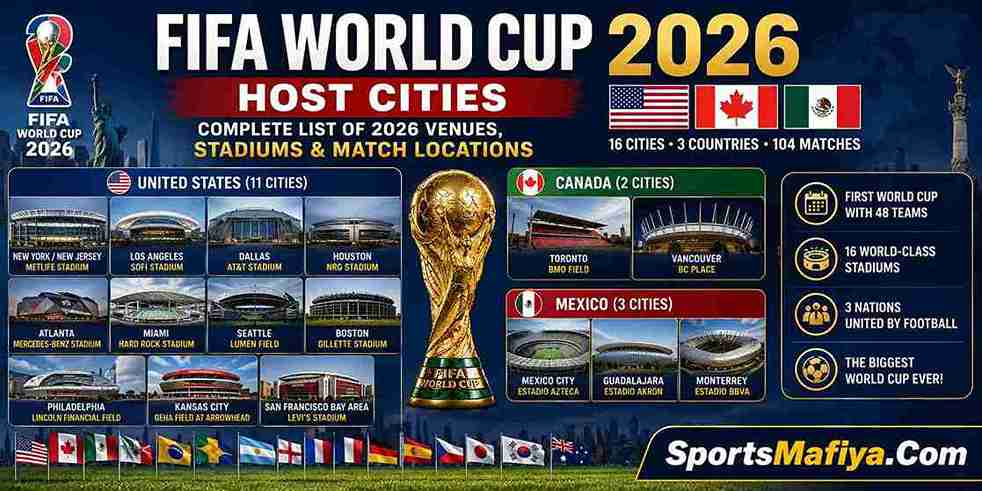

FIFA World Cup host cities: The FIFA World Cup 2026 is making history as the first tournament to be jointly hosted by three countries: the United States, Canada, and Mexico. Along with the expanded 48-team format, the tournament will feature 16 host cities and some of the most iconic football stadiums in North America.
From the legendary Estadio Azteca in Mexico City to the world-class MetLife Stadium in New Jersey, every host city has been selected to provide fans with unforgettable football experiences. These venues will welcome millions of supporters from around the globe while showcasing the culture, hospitality, and sporting passion of the three host nations.
In this guide, you’ll find the complete list of FIFA World Cup 2026 host cities, their stadiums, capacities, notable features, and the role each city will play during the tournament.
If you’re following the competition, don’t forget to explore our FIFA World Cup 2026 Schedule, Groups Explained, Standings, Golden Boot Race, Winners List, and Records guides.
FIFA World Cup 2026 Host Cities Highlights
| Feature | Details |
|---|---|
| Tournament | FIFA World Cup 2026 |
| Host Countries | United States, Canada & Mexico |
| Total Host Cities | 16 |
| Total Stadiums | 16 |
| Teams | 48 |
| Total Matches | 104 |
| Opening Match | Estadio Azteca, Mexico City |
| Final Venue | MetLife Stadium, New Jersey |
| Largest Stadium | AT&T Stadium, Arlington (Approx. 92,000+) |
| Historic Venue | Estadio Azteca (First stadium to host three World Cups) |
FIFA World Cup 2026 Host Cities Overview
For the first time in FIFA World Cup history, three nations will share hosting responsibilities.
The tournament will be played across 16 cities, with 11 venues in the United States, 2 in Canada, and 3 in Mexico.
Each city has been selected based on stadium quality, infrastructure, transportation, accommodation, and its ability to host large international sporting events.
The wide geographic spread also allows football fans to experience different cultures, climates, and iconic landmarks throughout North America.
United States Host Cities
The United States hosts the majority of the tournament, with eleven cities staging matches from the group stage through the knockout rounds.
New York / New Jersey
- Stadium: MetLife Stadium
- Capacity: Approximately 82,500
- Highlight: Hosts the FIFA World Cup 2026 Final.
Los Angeles, California
- Stadium: SoFi Stadium
- Capacity: Approximately 70,000+
- Highlight: One of the world’s most technologically advanced sports venues.
Dallas (Arlington), Texas
- Stadium: AT&T Stadium
- Capacity: Up to 92,000+
- Highlight: The largest venue selected for the tournament.
Houston, Texas
- Stadium: NRG Stadium
- Capacity: Around 72,000
- Highlight: Known for hosting major international sporting events.
Atlanta, Georgia
- Stadium: Mercedes-Benz Stadium
- Capacity: Around 75,000
- Highlight: Features a unique retractable roof and 360-degree video board.
Miami, Florida
- Stadium: Hard Rock Stadium
- Capacity: Around 65,000
- Highlight: Popular destination with a vibrant football fan base.
Seattle, Washington
- Stadium: Lumen Field
- Capacity: Around 69,000
- Highlight: Famous for one of the loudest crowds in football.
Boston (Foxborough), Massachusetts
- Stadium: Gillette Stadium
- Capacity: Around 65,000
- Highlight: Experienced venue for major international matches.
Philadelphia, Pennsylvania
- Stadium: Lincoln Financial Field
- Capacity: Around 69,000
- Highlight: Strong sporting tradition and passionate supporters.
Kansas City, Missouri
- Stadium: GEHA Field at Arrowhead Stadium
- Capacity: Around 76,000
- Highlight: Renowned for its electric atmosphere.
San Francisco Bay Area (Santa Clara), California
- Stadium: Levi’s Stadium
- Capacity: Around 68,500
- Highlight: Modern venue located in the heart of Silicon Valley.
Canada Host Cities
Canada hosts the FIFA World Cup for the first time in its history.
Toronto, Ontario
- Stadium: BMO Field (Expanded for the World Cup)
- Capacity: Approximately 45,000
- Highlight: Canada’s largest football event venue during the tournament.
Vancouver, British Columbia
- Stadium: BC Place
- Capacity: Around 54,000
- Highlight: Features a retractable roof and has hosted numerous international competitions.
Mexico Host Cities
Mexico becomes the first country to host matches in three different FIFA World Cups (1970, 1986, and 2026).
Mexico City
- Stadium: Estadio Azteca
- Capacity: Approximately 87,000
- Highlight: Scheduled to host the opening match and becomes the first stadium to stage matches in three FIFA World Cups.
Guadalajara
- Stadium: Estadio Akron
- Capacity: Around 49,000
- Highlight: Home to one of Mexico’s most successful football clubs.
Monterrey
- Stadium: Estadio BBVA
- Capacity: Around 53,000
- Highlight: Considered one of the most modern football stadiums in Latin America.
Which City Will Host the Final?
The FIFA World Cup 2026 Final will take place at MetLife Stadium in New Jersey.
With a seating capacity of more than 82,000, the stadium has previously hosted major international sporting events and is expected to welcome fans from across the world for football’s biggest match.
Which City Hosts the Opening Match?
The tournament begins at Estadio Azteca in Mexico City.
This iconic venue has previously hosted the World Cup finals in 1970 and 1986, making it one of the most historic stadiums in football history.
Why Were These Cities Selected?
FIFA evaluates several factors before selecting host cities, including:
- Stadium quality
- Transportation infrastructure
- Hotel availability
- Security and public safety
- Training facilities
- Fan experience
- Environmental sustainability
Each selected city demonstrated the ability to host large-scale international events while providing an exceptional experience for players and supporters.
What Makes the 2026 Host Cities Unique?
The FIFA World Cup 2026 host cities offer remarkable diversity.
Fans can experience:
- Historic football venues in Mexico.
- Cutting-edge stadiums in the United States.
- Canada’s welcoming football culture.
- Different climates, cuisines, and tourist attractions.
- Modern transportation networks connecting host cities.
The tournament is expected to attract millions of visitors and generate significant economic benefits across North America.
Frequently Asked Questions
| How many host cities are there in FIFA World Cup 2026? |
|---|
| The tournament features 16 host cities across three countries. |
| Which countries are hosting the FIFA World Cup 2026? |
| The United States, Canada, and Mexico are the official hosts. |
| Which stadium hosts the FIFA World Cup 2026 Final? |
| MetLife Stadium in New Jersey will host the final. |
| Which stadium hosts the opening match? |
| The opening match will be played at Estadio Azteca in Mexico City. |
| Which country has the most host cities? |
| The United States has 11 host cities, more than Canada and Mexico combined. |
Final Thoughts
The FIFA World Cup 2026 host cities represent one of the most ambitious hosting plans in football history. With 16 world-class venues spread across the United States, Canada, and Mexico, the tournament promises an unforgettable experience for players and fans alike.
From the historic atmosphere of Estadio Azteca to the modern grandeur of MetLife Stadium, each host city will play a crucial role in shaping the story of the biggest FIFA World Cup ever. As the tournament unfolds, these iconic destinations will witness unforgettable goals, passionate supporters, and football history in the making.
For complete coverage of the tournament, explore our FIFA World Cup pillar guide along with our FIFA World Cup 2026 Standings, Schedule, Groups Explained, Golden Boot Race, Winners List, and Records articles.