
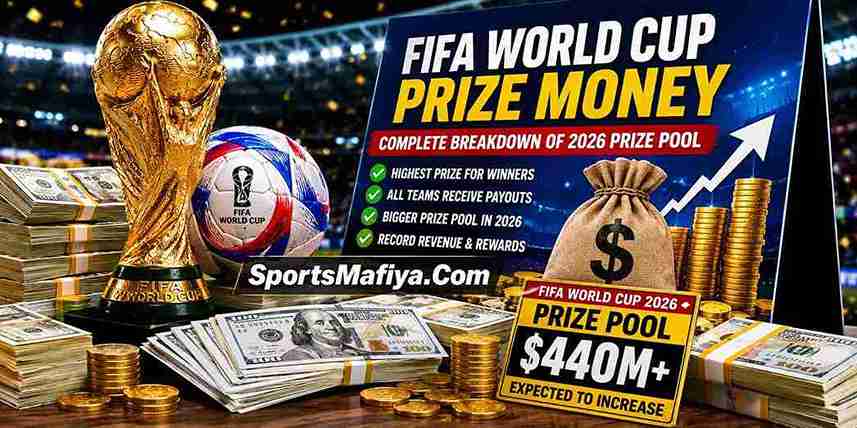

FIFA World Cup prize money: The FIFA World Cup is not only the most prestigious tournament in international football but also one of the most financially rewarding sporting events in the world. Every four years, the world’s best national teams compete not only for football’s most iconic trophy but also for a share of a massive prize pool distributed by FIFA.
With the expansion to 48 teams in the FIFA World Cup 2026, the tournament has reached unprecedented levels in terms of scale, commercial value, sponsorship, broadcasting revenue, and financial rewards. FIFA has significantly increased its investment in participating nations, ensuring that even teams eliminated in the group stage receive substantial financial support.
In this guide, you’ll learn everything about FIFA World Cup prize money, including the estimated 2026 prize pool, how prize money is distributed, previous tournament payouts, how teams use the money, and why the World Cup has become one of the richest sporting competitions on the planet.
If you’re following the tournament, also explore our FIFA World Cup 2026 Standings, Schedule, Groups Explained, Golden Boot Race, Winners List, Records, and Host Cities guides.
FIFA World Cup 2026 Prize Money Highlights
| Feature | Details |
|---|---|
| Tournament | FIFA World Cup 2026 |
| Hosts | United States, Canada & Mexico |
| Teams | 48 |
| Total Matches | 104 |
| Estimated Total Prize Pool | Expected to exceed FIFA World Cup 2022 |
| Prize Distribution | All Qualified Teams Receive Prize Money |
| Highest Prize | FIFA World Cup Champions |
| Organizing Body | FIFA |
What Is FIFA World Cup Prize Money?
FIFA World Cup prize money refers to the financial rewards distributed by FIFA to all participating national football associations based on their performance during the tournament.
Unlike club competitions where prize money is shared among clubs and players through contracts, World Cup prize money is paid to the national football associations. Each federation then determines how funds are allocated among players, coaching staff, football development programs, bonuses, and operational expenses.
The deeper a team progresses in the tournament, the larger its financial reward.
FIFA World Cup 2026 Prize Pool
At the time of writing, FIFA has not officially announced the complete prize money breakdown for the 2026 FIFA World Cup.
However, because the tournament has expanded from 32 to 48 teams and from 64 to 104 matches, experts expect the overall prize fund to increase significantly compared to the previous edition.
With record-breaking broadcasting rights, sponsorship agreements, ticket sales, and commercial partnerships, the 2026 tournament is expected to feature the largest prize pool in FIFA World Cup history.
An official breakdown will be published by FIFA closer to the tournament.
FIFA World Cup 2022 Prize Money Breakdown
The 2022 FIFA World Cup in Qatar featured a total prize pool of US$440 million, distributed among all participating nations.
| Finishing Position | Prize Money (USD) |
|---|---|
| Champions | $42 Million |
| Runners-up | $30 Million |
| Third Place | $27 Million |
| Fourth Place | $25 Million |
| Quarter-finalists | $17 Million |
| Round of 16 | $13 Million |
| Group Stage Teams | $9 Million |
These figures serve as the benchmark for estimating the 2026 payouts.
How FIFA Distributes Prize Money
Prize money is awarded according to a team’s final position in the tournament.
Teams eliminated in the group stage receive the smallest payout, while each advancement through the knockout rounds increases the financial reward.
This system encourages competitive performance while ensuring that every qualified nation benefits financially from participating in the World Cup.
How National Teams Use Prize Money
Prize money is typically used for several purposes beyond player bonuses.
Common uses include:
- Player performance bonuses.
- Coaching and technical staff incentives.
- Youth football development.
- National football infrastructure.
- Training facilities.
- Grassroots football programs.
- Federation operating expenses.
- Women’s football development initiatives.
Many countries invest a significant portion of their World Cup earnings into improving football for future generations.
Which Team Earns the Most Prize Money?
The FIFA World Cup champions receive the largest financial reward.
In addition to lifting the famous trophy, the winning nation receives the highest prize payout, increased sponsorship opportunities, greater commercial value, and long-term financial benefits from global recognition.
Winning the World Cup often generates millions of dollars in additional revenue through merchandising, broadcasting exposure, tourism, and endorsement deals.
FIFA World Cup Prize Money Growth
World Cup prize money has increased dramatically over the decades.
| Tournament | Total Prize Pool |
|---|---|
| 2006 | $266 Million |
| 2010 | $420 Million |
| 2014 | $576 Million |
| 2018 | $400 Million |
| 2022 | $440 Million |
| 2026 | Expected to Increase |
The steady growth reflects football’s expanding global audience and increasing commercial success.
Why Has Prize Money Increased?
Several factors contribute to higher World Cup prize funds.
These include:
- Increased television broadcasting rights.
- Global sponsorship deals.
- Higher ticket sales.
- Digital streaming revenue.
- Expanded tournament format.
- Greater international fan engagement.
- Commercial partnerships with global brands.
As football continues to grow worldwide, FIFA generates record revenues that allow larger financial rewards for participating nations.
Does Every Team Receive Prize Money?
Yes.
Every nation that qualifies for the FIFA World Cup receives prize money, even if it fails to advance beyond the group stage.
Qualification itself is a major achievement, and FIFA ensures that all participating associations receive financial support to offset preparation costs and encourage football development.
Do Players Receive the Entire Prize Money?
Not directly.
FIFA pays the prize money to each country’s football association.
Individual players usually receive bonuses based on agreements negotiated with their national federation before the tournament begins.
The remaining funds are typically invested in football development and federation activities.
Financial Impact of Winning the FIFA World Cup
Winning the World Cup delivers benefits far beyond FIFA’s prize payment.
Champions often experience:
- Increased sponsorship revenue.
- Higher merchandise sales.
- Tourism growth.
- Stronger domestic football investment.
- Greater international recognition.
- Increased commercial partnerships.
The overall economic value of becoming world champions often exceeds the official prize money itself.
Will FIFA World Cup 2026 Have the Largest Prize Pool Ever?
Most football analysts expect the answer to be yes.
With:
- 48 participating nations.
- 104 matches.
- Three host countries.
- Record global television audiences.
- Expanded sponsorship agreements.
The FIFA World Cup 2026 is expected to become the richest tournament in football history.
The official figures will be announced by FIFA before the tournament begins.
Frequently Asked Questions (FAQs)
| What is the FIFA World Cup prize money? |
|---|
| It is the financial reward distributed by FIFA to participating national football associations based on their tournament performance. |
| How much did the FIFA World Cup 2022 winners receive? |
| Argentina received US$42 million after winning the 2022 FIFA World Cup. |
| Does every qualified team receive prize money? |
| Yes. Every participating nation receives a guaranteed payout, even if it is eliminated during the group stage. |
| Has FIFA announced the 2026 prize money? |
| No. FIFA has not yet released the official 2026 prize money distribution. However, the total prize pool is expected to exceed that of the 2022 tournament. |
| Who receives the FIFA prize money? |
| The money is paid to each national football association, which then distributes funds according to its own policies and agreements. |
Final Thoughts
The FIFA World Cup prize money reflects the tournament’s status as the biggest event in international football. As broadcasting revenues, sponsorships, and global audiences continue to grow, so too does the financial reward for participating nations.
The FIFA World Cup 2026 is expected to feature the largest prize pool in tournament history, providing greater financial incentives for every qualified nation. While lifting the World Cup trophy remains the ultimate goal, the tournament’s expanding prize fund also supports the long-term growth of football around the world.
For complete FIFA World Cup coverage, explore our FIFA World Cup pillar guide along with our FIFA World Cup 2026 Standings, Schedule, Groups Explained, Golden Boot Race, Winners List, Records, and Host Cities articles.



Great content! Keep up the good work!