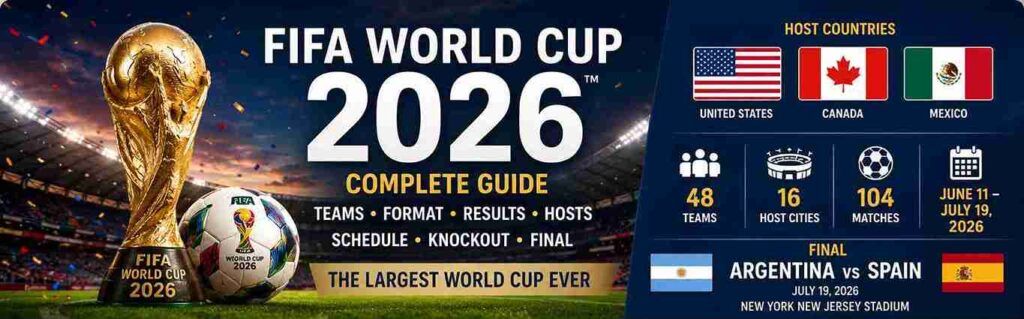

The FIFA World Cup 2026 has rewritten the scale of international football. Hosted jointly by the United States, Canada, and Mexico, the 23rd edition of the men’s FIFA World Cup became the first in history to feature 48 national teams, creating a significantly larger competition with 104 matches across 16 host cities.
The tournament began on June 11, 2026, and reaches its conclusion on July 19, 2026, with Argentina and Spain contesting the FIFA World Cup 2026 final at New York New Jersey Stadium. The expanded competition has introduced new nations to football’s biggest stage, created an additional knockout round, and tested elite squads across a longer route to the trophy.
Spain Conquer the World
Spain are crowned FIFA World Cup 2026 champions after defeating Argentina 1–0 in the final, completing an unforgettable journey to football’s ultimate prize.
This comprehensive guide examines the FIFA World Cup 2026 format, host countries, tournament structure, qualified teams, major results, knockout stage, standout performers, tactical trends, and the broader significance of the largest World Cup ever staged.
FIFA World Cup 2026 Overview
| Tournament Detail | Information |
|---|---|
| Tournament | FIFA World Cup 2026 |
| Edition | 23rd |
| Host Countries | United States, Canada and Mexico |
| Start Date | June 11, 2026 |
| Final | July 19, 2026 |
| Participating Teams | 48 |
| Groups | 12 |
| Teams per Group | 4 |
| Total Matches | 104 |
| Host Cities | 16 |
| Defending Champion at Start | Argentina |
| Finalists | Argentina and Spain |
| Final Venue | New York New Jersey Stadium |
The 2026 tournament represents the biggest structural transformation of the men’s World Cup in decades. Previous editions from 1998 through 2022 featured 32 teams and 64 matches. The expansion to 48 teams added 16 national sides and increased the tournament to 104 fixtures.
That change is more than numerical. It has reshaped qualification, group-stage strategy, squad management and the knockout pathway.
Why the FIFA World Cup 2026 Is Historic
Several factors make the 2026 edition unique.
First, it is the first men’s World Cup hosted across three countries. While previous editions have had joint hosts, no men’s tournament had previously been staged simultaneously in three nations.
Second, the competition expanded from 32 to 48 teams, providing more countries with an opportunity to compete at the highest level.
Third, the tournament introduced a Round of 32, meaning the eventual finalists must navigate an additional knockout stage compared with the format used at the 2022 World Cup.
Finally, the geographical scale is enormous. Matches have been staged across Canada, Mexico and the United States, creating a continental tournament involving major differences in climate, travel distance and playing conditions.
For coaches and players, therefore, World Cup 2026 has not simply been a bigger tournament. It has been a more complex logistical and competitive challenge.
FIFA World Cup 2026 Host Countries
The tournament is jointly hosted by three CONCACAF nations:
United States
The United States hosts the majority of matches and provides many of the tournament’s largest stadiums. It previously hosted the men’s World Cup in 1994.
Mexico
Mexico has made history by becoming the first country to host matches at three different men’s FIFA World Cups, following its previous tournaments in 1970 and 1986.
Canada
Canada is hosting men’s FIFA World Cup matches for the first time, adding another landmark moment to the country’s growing football history.
Together, the three nations have transformed the 2026 World Cup into a genuinely continental sporting event.
FIFA World Cup 2026 Format Explained
The expanded format is one of the most important changes introduced for 2026.
The 48 participating teams were divided into 12 groups of four teams each.
Every team played three matches during the group stage.
The teams progressing to the knockout rounds were:
- The top two teams from each of the 12 groups
- The eight best third-placed teams
This created a 32-team knockout field.
From there, the competition followed a single-elimination structure:
Round of 32 → Round of 16 → Quarterfinals → Semifinals → Final
The two losing semifinalists also competed in the third-place playoff.
The new format means a team reaching the final can play as many as eight matches, compared with seven under the previous 32-team system.
How the Best Third-Placed Teams Changed Group Strategy
One of the most strategically significant elements of the expanded format is the qualification of eight third-placed teams.
Under the old system, finishing outside the top two meant immediate elimination. In 2026, third place can still provide a pathway into the knockout rounds.
That fundamentally changes the mathematics of the group stage.
A team losing its opening match can remain firmly alive. Goal difference becomes increasingly important, and coaches must balance the need to chase victories against the danger of suffering heavy defeats.
The system also creates uncertainty across groups because qualification can depend on results elsewhere in the tournament.
As a result, the final round of group matches becomes a giant interconnected puzzle involving points, goal difference, goals scored and comparative third-place standings.
Also Read:
- FIFA World Cup 2026 Schedule
- FIFA World Cup 2026 Standings
- FIFA World Cup Winners List (1930–2026)
- FIFA World Cup Golden Boot Winners
- FIFA World Cup Golden Ball Winners
FIFA World Cup 2026 Groups
The expanded tournament featured 12 groups, running from Group A to Group L.
The competition included established football powers alongside emerging nations and several teams making their World Cup debuts.
The group stage produced intriguing combinations of traditional contenders and ambitious challengers, including teams such as Argentina, Brazil, France, Spain, England, Germany, Portugal, the Netherlands and the three host nations.
The larger field also gave countries with limited previous World Cup exposure an opportunity to compete against football’s biggest names.
That broader representation is one of the central arguments supporting expansion: more nations can participate directly in the world’s most watched football competition rather than experiencing the tournament only through qualification.
FIFA World Cup 2026 Knockout Stage
The introduction of the Round of 32 created a longer and less forgiving route to the trophy.
Round of 32
- The first knockout round immediately produced high-pressure football. Among the teams progressing were Canada, Brazil, Paraguay, Morocco, Norway, France, Mexico, England, Belgium, the United States, Spain, Portugal, Switzerland, Egypt, Argentina and Colombia.
- Several established teams were eliminated earlier than expected, demonstrating one of the defining characteristics of knockout football: reputation offers no protection once the margins become razor-thin.
Round of 16
- The tournament intensified dramatically in the Round of 16.
- Morocco defeated Canada, while France overcame Paraguay.
- One of the tournament’s biggest results arrived when Norway eliminated Brazil, ending the five-time world champions’ campaign.
- England progressed past Mexico, Spain defeated Portugal, and Belgium ended the United States’ run.
- Argentina advanced after a high-scoring contest against Egypt, while Switzerland progressed against Colombia following a penalty shootout.
Quarterfinals
- The final eight featured an intriguing mixture of traditional giants and tournament disruptors.
- France defeated Morocco to reach the semifinals, while Spain overcame Belgium.
- England ended Norway’s remarkable campaign, while defending champions Argentina defeated Switzerland.
- The semifinal lineup was therefore:
France vs Spain
England vs Argentina
Semifinals
- Spain produced a major performance to defeat France and book a place in the World Cup final.
- Argentina then overcame England to secure another appearance in football’s biggest match.
- The results created a heavyweight final between Spain and defending champions Argentina, bringing together two teams with different footballing identities and two generations of global stars.
Argentina vs Spain: The FIFA World Cup 2026 Final
The 2026 World Cup concludes with Argentina facing Spain at New York New Jersey Stadium on July 19, 2026.
The matchup carries extraordinary sporting significance.
Argentina entered the tournament as defending world champions and successfully navigated another deep knockout run. Spain arrived at the final after eliminating France in the semifinal and establishing themselves as one of the strongest technical teams in the competition.
The match also creates a compelling generational storyline around Lionel Messi and Lamine Yamal.
Messi represents one of the defining figures in football history, while Yamal symbolizes the emergence of a new generation at the elite level.
Yet reducing the final to two individuals would overlook the tactical depth of both teams.
Argentina’s route has been built around competitive control, experience and the ability to survive difficult moments. Spain’s approach emphasizes possession, technical quality, positional movement and attacking width.
The result is a fascinating clash of footballing philosophies at the final hurdle of the longest World Cup in history.
Editor’s Update: The final result and confirmed 2026 world champion should be added here once the Argentina vs Spain final is officially completed.
England Finish Third After Extraordinary Bronze Match
England and France contested the third-place playoff after their respective semifinal defeats.
The match developed into an extraordinary attacking contest, with England defeating France 6-4.
Although the bronze medal match does not carry the same prestige as the final, the ten-goal spectacle provided another dramatic chapter in an already eventful tournament.
England therefore secured third place at FIFA World Cup 2026, while France finished fourth.
Tactical Trends That Defined World Cup 2026
Beyond individual results, the tournament has highlighted several broader developments in modern international football.
High Pressing Is No Longer Enough
Elite teams increasingly use selective rather than constant pressing.
The best sides identify specific triggers, such as backward passes, poor first touches or passes toward isolated full-backs, before aggressively closing space.
This allows teams to preserve energy during a tournament in which finalists can play eight matches.
Goalkeepers Are Becoming Outfield Playmakers
Modern goalkeepers are expected to do far more than stop shots.
Their positioning during buildup can effectively create an additional passing player, allowing teams to escape pressure and generate numerical advantages.
At the same time, aggressive goalkeeper positioning carries significant risk against opponents capable of pressing intelligently.
Width Remains a Critical Weapon
Compact defensive blocks have made central spaces increasingly difficult to penetrate.
As a result, elite teams frequently stretch opponents through wide attackers and attacking full-backs before exploiting gaps created inside.
The tactical battle is often not simply about possession percentage but about where possession forces the defending team to move.
Squad Depth Matters More Than Ever
The expanded format has increased the physical demands placed on teams reaching the latter stages.
Rotation, recovery and bench quality have therefore become strategically important.
Winning a modern World Cup increasingly requires more than an outstanding starting XI. Teams need multiple tactical options and players capable of changing matches from the bench.
The Physical Challenge of a 104-Match World Cup
The scale of the 2026 tournament introduces challenges that extend beyond football tactics.
Teams must manage travel across an enormous geographical area while adapting to different weather conditions, stadium environments and recovery schedules.
For individual players, the competition arrives after demanding domestic seasons. Those reaching the final stages face an intense accumulation of matches.
This makes sports science, recovery management, nutrition and squad rotation central components of tournament strategy.
In a competition decided by tiny margins, an extra day of recovery or a successfully rotated starting lineup can become as important as a tactical adjustment.
Major Surprises of FIFA World Cup 2026
Every World Cup produces unexpected stories, and 2026 has been no exception.
Norway’s victory over Brazil in the Round of 16 represented one of the tournament’s defining upsets before England ended their run in the quarterfinals.
Morocco again demonstrated its ability to compete deep into major international tournaments, reaching the quarterfinal stage.
The expanded format also allowed more nations to experience knockout football, increasing the possibility of unexpected results.
That unpredictability is essential to the World Cup’s appeal. The tournament is not simply a ranking exercise designed to confirm the strongest team on paper. It is a compressed competition in which momentum, tactical preparation and individual moments can overturn expectations within 90 minutes.
What the 48-Team Expansion Means for the Future
The expansion remains one of the most debated developments in international football.
Supporters argue that a 48-team World Cup makes the competition more genuinely global. More countries gain access to the tournament, more supporters see their national teams represented, and football receives greater exposure in developing markets.
Critics question whether expansion can dilute competitive quality and create scheduling or player-welfare concerns.
The 2026 edition provides the first major real-world test of that debate.
What is undeniable is that the World Cup has entered a new era.
The tournament is now larger, longer and geographically broader. Qualification has become accessible to more nations, while the path to becoming world champion has become physically demanding because of the additional knockout round.
Future assessments of the 48-team format will therefore depend on balancing global inclusion against competitive quality and player welfare.
FIFA World Cup 2026 Records and Historic Milestones
The tournament has already established several major historical benchmarks.
It is the:
- First men’s FIFA World Cup with 48 teams
- First men’s World Cup hosted by three countries
- First men’s World Cup featuring 104 matches
- First edition under the new 12-group structure
- First men’s World Cup hosted in Canada
- Third men’s World Cup hosted at least partly by Mexico
- Second men’s World Cup hosted at least partly by the United States
These milestones ensure that the 2026 edition will remain an important reference point in World Cup history regardless of the final result.
FIFA World Cup 2026 Frequently Asked Questions
| Where was the FIFA World Cup 2026 held? |
|---|
| The tournament was jointly hosted by the United States, Canada and Mexico. |
| How many teams participated in FIFA World Cup 2026? |
| A total of 48 teams participated, making it the largest men’s FIFA World Cup to date. |
| How many matches were played at the 2026 World Cup? |
| The expanded tournament features 104 matches. |
| How many groups were there? |
| The 48 teams were divided into 12 groups of four. |
| How did teams qualify for the knockout stage? |
| The top two teams from every group advanced alongside the eight best third-placed teams, creating a 32-team knockout stage. |
| Who reached the FIFA World Cup 2026 final? |
| Argentina and Spain reached the final. |
| Who finished third at FIFA World Cup 2026? |
| England secured third place after defeating France 6-4 in the bronze-medal match. |
| Where was the 2026 World Cup final played? |
| The final was staged at New York New Jersey Stadium in the United States. |
| When was the FIFA World Cup 2026 final? |
| The final was scheduled for July 19, 2026. |
| Who won the FIFA World Cup 2026? |
| At the time this article was prepared, the final between Argentina and Spain was still in progress. The confirmed champion should be updated after the official final result. |
At the time this article was prepared, the final between Argentina and Spain was still in progress. The confirmed champion should be updated after the official final result.
Conclusion
The FIFA World Cup 2026 represents a turning point in the history of international football.
Its significance extends far beyond the identity of the eventual champion. The tournament introduced the 48-team era, expanded the knockout stage, brought the World Cup to three host nations and created the largest competition the sport has ever staged.
The tournament has also provided compelling sporting narratives: Brazil’s unexpected elimination, Norway’s breakthrough run, Morocco’s continued competitiveness, England’s third-place finish, Spain’s rise to the final and Argentina’s attempt to defend the world title.
At its core, however, the World Cup remains governed by the same brutal simplicity that has defined it for generations. Forty-eight teams entered with the same ambition, but only one can leave as world champion.
As Argentina and Spain contest the final chapter, FIFA World Cup 2026 stands as both the conclusion of one tournament and the beginning of a dramatically expanded era for the world’s biggest football competition.