
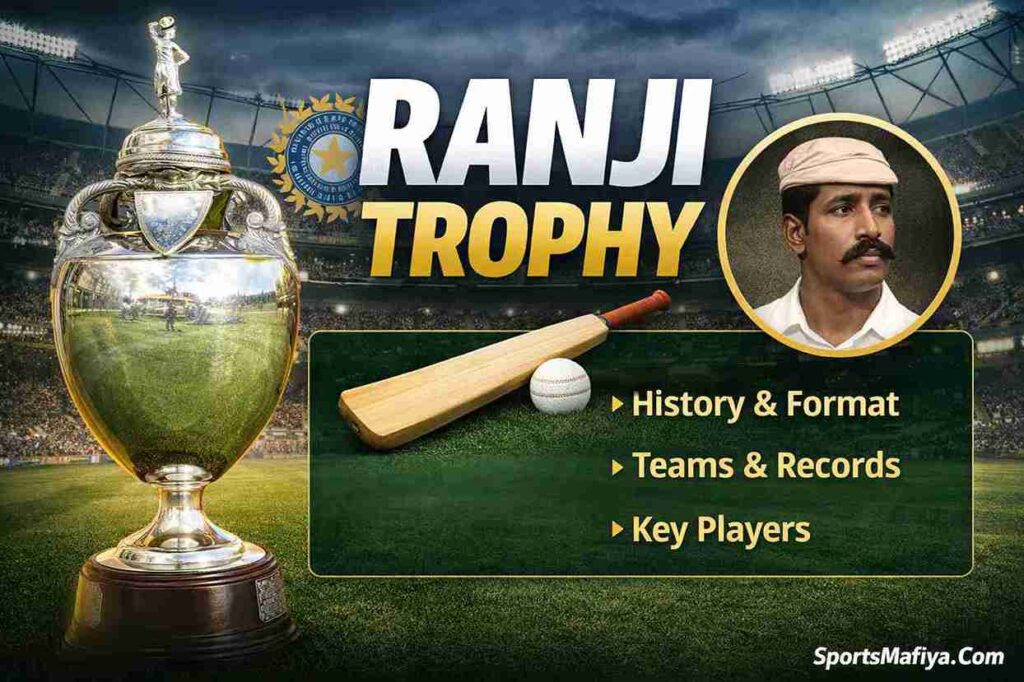

The Ranji Trophy is the premier domestic first-class cricket championship in India. It is organized annually by the Board of Control for Cricket in India (BCCI). Established in the 1934–35 season, the tournament represents the highest level of domestic red-ball cricket in the country.
The competition is contested by regional and state teams representing various cricket associations across India. Matches are played in the first-class format, typically over four days, and the tournament serves as a key platform for identifying and developing players for the Indian national team.
The Ranji Trophy is named after Ranjitsinhji, a former Indian princely cricketer who represented England in international cricket. Over the decades, the tournament has evolved in structure and scale, reflecting changes in Indian domestic cricket.
📊 Key Highlights
| Attribute | Details |
|---|---|
| Tournament Name | Ranji Trophy |
| Founded | 1934 |
| Governing Body | BCCI |
| Format | First-class cricket |
| Number of Teams | 38 (recent seasons) |
| Current Champion | Mumbai (2023–24) |
| Most Successful Team | Mumbai |
| Most Titles | 42 |
| First Winner | Bombay (Mumbai) |
| Tournament Structure | Elite & Plate groups (varies by season) |
| Season Duration | November to March |
| Named After | Ranjitsinhji |
The Ranji Trophy is widely recognized as the backbone of India’s domestic cricket structure. It provides a competitive environment for players to perform in multi-day matches, which are essential for developing skills required in Test cricket. The tournament has consistently served as a pathway to international selection, producing numerous players who have gone on to represent India at the highest level. Its long history and evolving format reflect the growth of cricket in India. The competition remains central to talent identification, performance assessment, and the overall development of red-ball cricket within the country.
History
The Ranji Trophy was introduced in the 1934–35 season as India’s first national-level domestic cricket competition. It was named in honor of Ranjitsinhji, a prominent cricketer known for his contributions to the sport.
In its early years, the tournament followed a knockout format, with teams representing major regions such as Bombay, Madras, and Bengal. Bombay (now Mumbai) emerged as the first winner and later became the most dominant team in the tournament’s history.
Over time, the structure of the competition evolved. Zonal formats were introduced, followed by league systems to ensure more matches for participating teams. In recent decades, the tournament has seen the introduction of Elite and Plate divisions, along with promotion and relegation systems. These changes were implemented to enhance competitiveness and provide equal opportunities for emerging teams.
Tournament Structure
The Ranji Trophy is played in a combination of league and knockout formats. Teams are divided into groups, and each team plays multiple matches within its group during the league stage.
Points are awarded based on match results, including wins, draws, and bonus points for first-innings leads. The top-performing teams from each group qualify for the knockout stage, which includes quarter-finals, semi-finals, and the final.
In some seasons, the competition has been divided into Elite and Plate groups. Teams in the Plate group compete for promotion to the Elite division, while lower-performing Elite teams may face relegation. This system aims to maintain competitive balance across the tournament.
Teams and Participation
The tournament features teams representing Indian states and regional cricket associations. These include traditional teams such as Mumbai, Delhi, Karnataka, and Tamil Nadu, along with newer teams like Chhattisgarh and Uttarakhand.
The number of participating teams has increased over time, reflecting the expansion of cricket infrastructure in India. Initially limited to a few regional sides, the tournament now includes 38 teams in recent seasons.
This expansion has allowed broader participation and improved representation from different parts of the country, contributing to the overall development of domestic cricket.
Domestic Importance
The Ranji Trophy plays a central role in Indian cricket. It serves as the primary platform for players aspiring to represent the national team in Test cricket.
Performances in the tournament are closely monitored by selectors, making it a key pathway for selection into the Indian team. Many players have progressed from strong domestic performances to successful international careers.
The tournament also helps in identifying emerging talent and provides players with experience in longer formats, which require technical skill, patience, and consistency.
Notable Records and Statistics
- Most successful team: Mumbai
- Most titles: 42 (Mumbai)
- Most runs in tournament history: Wasim Jaffer
- Most wickets in tournament history: Rajinder Goel
- Highest individual score: 443 (B. B. Nimbalkar, 1948–49)
- Best bowling figures: 10/20 (Premangsu Chatterjee, unofficial record context)
- Highest team total: Over 900 runs (multiple instances, including Hyderabad)
These records highlight the longevity and competitive nature of the tournament.
Legendary Players
Several prominent Indian cricketers have participated in the Ranji Trophy during their careers:
- Sachin Tendulkar – Represented Mumbai and scored a century on debut
- Rahul Dravid – Played for Karnataka and was known for consistent performances
- Sunil Gavaskar – Represented Bombay and contributed significantly to domestic cricket
These players used the Ranji Trophy as a platform to establish themselves before achieving success at the international level.
Memorable Matches and Moments
The Ranji Trophy has produced several notable matches and performances over the years.
Historic finals, particularly involving Mumbai, have often set benchmarks in domestic cricket. Record-breaking performances, including triple and quadruple centuries, have been recorded in the tournament.
There have also been unexpected victories by less-established teams, demonstrating the increasing competitiveness of the competition. Such moments have contributed to the tournament’s significance in Indian cricket history.
Recent Developments
In recent seasons, the Ranji Trophy has undergone structural and operational changes. The introduction of Elite and Plate divisions has allowed for better competition management.
The 2023–24 season saw Mumbai secure another title, reinforcing its historical dominance. Technological advancements, including improved broadcasting and limited use of Decision Review System (DRS) in certain matches, have enhanced the viewing and officiating standards.
Efforts have also been made to align domestic schedules with international calendars to manage player workload effectively.
Comparison with Other Domestic Tournaments
The Ranji Trophy is often compared with other Indian domestic competitions:
- Duleep Trophy – A zonal competition featuring selected players rather than state teams
- Irani Cup – Played between the Ranji Trophy champions and a Rest of India team
While these tournaments provide competitive opportunities, the Ranji Trophy remains the primary first-class competition in India.
Challenges and Criticism
The Ranji Trophy faces several challenges:
- Scheduling issues: Overlapping international and domestic fixtures
- Pitch quality concerns: Variation in pitch standards across venues
- Player workload: Balancing domestic and international commitments
These challenges are periodically addressed by the governing body through structural adjustments and policy changes.
Future Prospects
The future of the Ranji Trophy is linked to the continued growth of domestic cricket in India. Reforms in scheduling, infrastructure development, and technological integration are expected to enhance the tournament’s quality.
There is also an increased focus on maintaining the relevance of first-class cricket in an era dominated by shorter formats. The Ranji Trophy is expected to remain a key component of India’s cricket ecosystem, particularly for Test cricket preparation.
The Ranji Trophy remains India’s most significant domestic first-class cricket tournament. Since its establishment in 1934, it has played a crucial role in shaping the country’s cricketing structure.
Through its competitive format and wide participation, the tournament continues to serve as a platform for talent development and selection for the national team. Its historical importance and ongoing evolution ensure its continued relevance in Indian cricket.



Pingback: Duleep Trophy: History, Format, Teams & Winners - SportsMafiya